Home › Beginner projects
Woodworking projects for beginners: what to build first
Reviewed 30 August 2026 · how we research
The best beginner projects are cheap, quick, and teach one skill at a time. Skip the elaborate first build. These six move you from measuring and cutting to basic joinery without needing a full shop.
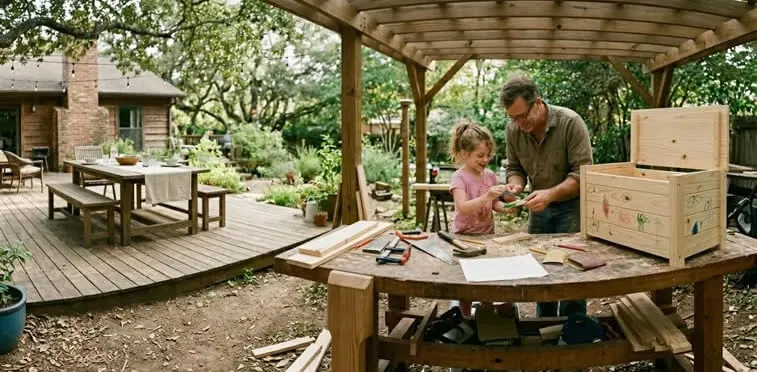
Six good first projects
- Cutting board - milling, gluing up flat, sanding through grits, a food-safe finish.
- Bench hook - accurate crosscuts and squareness; you then use it for everything else.
- Floating shelves - straight cuts, drilling for hidden brackets, finding studs, levelling.
- Planter box - simple butt joints, exterior screws, working with dimensional lumber.
- Step stool - dados or pocket screws, clamping a rigid assembly, load-bearing joints.
- Small side table - your first four-legged piece: leg length accuracy and a square frame.
The minimal tool kit
You can build all six with: a tape measure and a combination square, a hand saw or a circular saw, a drill/driver, a few clamps, a block plane or sanding block, and sandpaper. A pocket-hole jig is a cheap, high-value add. Everything else can wait.
Skills to practise deliberately
- Measuring and marking to a knife line or a sharp pencil, always from the same reference edge
- Cutting to the waste side of the line, then trimming to fit
- Checking square at every assembly step, not at the end
- Gluing up on a flat surface with even clamp pressure
Where plans fit
For these, a good free plan is fine, and the plan checklist here tells you which to trust. If you want a large catalogue of beginner-rated builds in one place, the Ted's Woodworking library has a dedicated beginner tier - our review covers the caveats.
FAQ
What is the best first woodworking project?
A cutting board or a bench hook. Both are cheap, forgiving, and teach core skills without joinery pressure.
What tools do I need to start woodworking?
A tape measure and combination square, a saw (hand or circular), a drill/driver, clamps, and sandpaper or a block plane. A pocket-hole jig is a worthwhile early addition.
How long until I can build furniture?
After four or five small projects that go well, a few weekends in, a simple side table or bookshelf is realistic.
What should I build after a cutting board?
A bench hook, then floating shelves, a planter, a step stool, and a small side table, adding one skill each time.
Do I need power tools to start woodworking?
No. A hand saw or circular saw, a drill, clamps, and sandpaper cover the first several projects.
How do I make accurate cuts as a beginner?
Mark with a knife or sharp pencil from one reference edge, cut to the waste side of the line, and trim to fit.
What is the most useful skill to practise first?
Squareness. Check it at every assembly step, not at the end.
How much should I expect to spend to start?
A modest hand-tool kit, roughly doubling with a sander and circular saw. Build several projects before investing more.
What is a realistic first-year goal?
Comfortable measuring, cutting, and assembling small projects, and one or two simple pieces of furniture.
Where can I learn technique for free?
Established woodworking sites and YouTube channels, paired with the plan you are building.
More: Beginner tool kit · Core techniques · Woodworking plans
Want to see what the bundle includes?
One-time payment advertised at $67, with a 60-day money-back guarantee through ClickBank. Prices and bonuses can change, so confirm them on the official page.
Affiliate link to the seller's own website. We may earn a commission at no extra cost to you.